Job boards are parking lots. Kynaa is a runway.

One platform where students prove what they can do, universities see where they land, and companies hire on evidence. Every AI decision explained in plain English.

Scroll to taxi

Hiring is a night flight with the lights off.

If you're a student

Three years of projects, internships and coursework become one PDF nobody opens. You apply, you wait, and silence is the only answer you get. You never find out what was missing.

If you're a university

Your placement cell runs on spreadsheets and phone calls. You know who got placed. You don't know why the rest didn't, which skills recruiters wanted this year, or where your programs fall short.

If you're hiring

Five hundred resumes, every one of them a "team player," and no way to tell who can do the job. So you shortlist by college name and hope.

So we lit the runway.

One strip, three sides, no black boxes. Students, universities and companies finally look at the same thing: the evidence.

A student's proof of work is what the recruiter scores. The recruiter's reasons are what the student reads. And the university sees both, for every student, in one place.

Every side of the table. One truth on it.

Each side gets its own workspace. All of them look at the same candidates, the same roles, the same outcomes.

Students

Know where you stand.

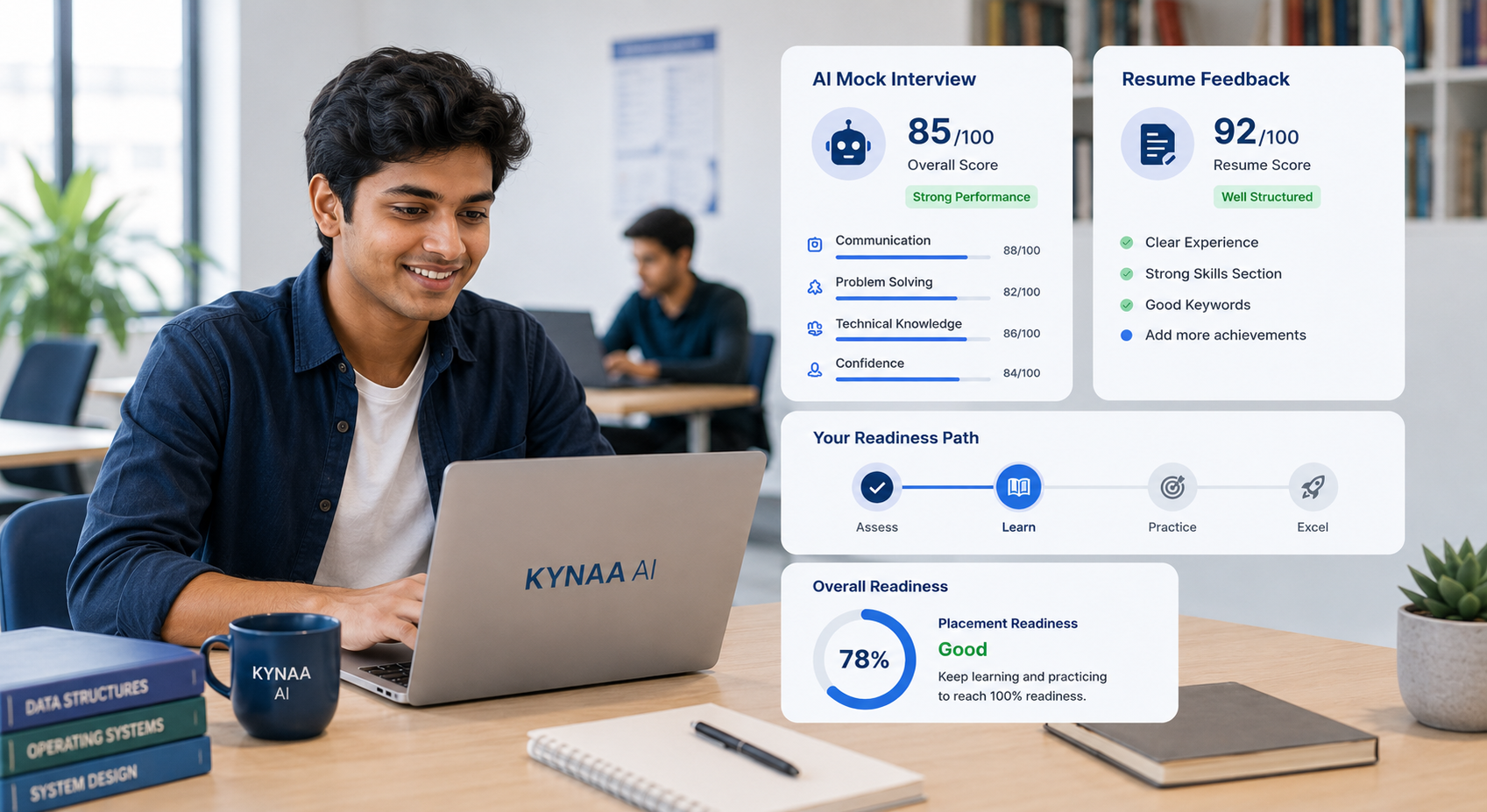
A profile that proves what you can do, matches built on evidence, and application status you can actually see.

  • Mock rounds with feedback you can act on
  • Every score explained, every gap named
  • No application goes silent

Student access comes through partner universities.

Universities

See your graduates land.

Placement visibility across cohorts, and a direct line between your programs and the companies hiring from them.

  • Live placement status for every drive and cohort
  • Readiness by skill, before the drive opens
  • One record per student, shared with recruiters
Kynaa for Universities

Corporates

Hire with your eyes open.

An agentic platform that runs the whole talent journey, ten stages from knowing who you need to learning from every hire. The agents do the legwork. Your team keeps the controls.

  • Every AI score opens into factors, evidence and confidence
  • Scoring weights are yours to set, per role family
  • Nothing ships without a human sign-off
Kynaa for Corporates

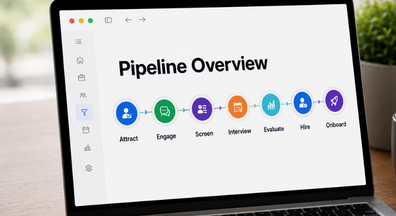
Ten stages. Zero dropped handoffs.

Most tools cover one slice of hiring and lose the candidate between systems. Kynaa covers the whole strip, and the candidate sees every step of it.

Stage 01 of 10

Demand

Know which roles you actually need, before you post a word.

The same runway, from three seats.

One record per student. One score per role. Three different screens, and nobody working from a different version of the truth.

StudentMayank's view
MG
Mayank GuptaB.Tech CSE, VIT Vellore
53readiness, up from 47
Day 7practice streak
3live applications
Software Engineer Intern, AppleShortlisted
Backend Engineer, GoogleInterview Thu
Data Analyst, MetaUnder review
Next step: add a team project to lift your Google score. Two mock rounds queued for tonight.
UniversityPlacement cell

CSE 2026 cohort

Three drives open this week
312students
148placed
61in process
Backend readiness71
Data structures readiness58
System design readiness44
Signal: Google and Meta weighted system design 40% this season. That's the gap to close before the next drive.
CorporatePriya's shortlist

Backend Engineer

Google, 6 finalists from 412 applicants
AN
Ananya N.VIT Vellore, 3 verified projects
86High confidence
RS
Rahul S.MIT Manipal, 2 verified projects
83High confidence
FK
Fatima K.BITS Dubai, UAE-eligible
81Needs a look
Shortlist readyWaiting for Priya's sign-off
Illustrative screens with demo data, not real people or placements.

Every score shows its work.

Most AI hiring tools hand you a number and ask for trust. Kynaa hands you the number, and the whole chain behind it.

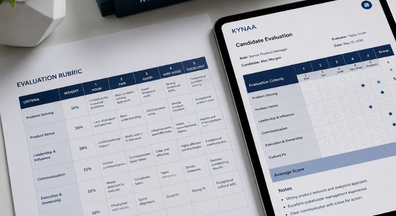
Pull the card apart. Behind the score sit the factors that drove it, the evidence for each factor, and how confident the system is. That's a chain a recruiter can defend to a hiring manager or an auditor.

The student sees the same chain. Same score, same reasons, same gaps. What a recruiter reads is what a student can act on.

Illustrative example, not a real candidate.
Score 1 of 4
AN
Ananya N.Backend Engineer, Google
86out of 100

One comparable number for this role.

Not a generic ranking. The same candidate scores differently against different roles, because different roles need different things. A score is a claim. The next three cards are the proof.

Factors 2 of 4

What drove the 86, and how much.

Skills match 40%
Project portfolio 25%
Assessments 25%
Education 10%

Weights are set by your admins, per role family. Not by us.

Evidence 3 of 4

The proof behind each factor.

  • Distributed task queue, course projectSource code and write-up, verified on profile
  • Data structures assessment, completedProctored, scored against the role's requirements
  • B.Tech CSE, VIT Vellore, in progressEnrollment verified through the university

Every item links to its source. Nothing is taken on faith.

Confidence 4 of 4

How sure the system is.

Confidence: High
Strong evidence coverage across skills and assessments. One gap worth a human look: no team-based project on file yet.

Low confidence doesn't hide. It asks for a person.

Click a card behind to bring it forward, or drag the stack.

Agents do the legwork. People make the calls.

Kynaa is agentic, not autonomous. Software handles the repetitive work that runs around the clock. Every decision that affects a person waits for a person.

What the agents run

Around the clock, for every side.
  • For companies: draft the job spec, source and screen against your weights, schedule interviews, chase follow-ups
  • For students: match open roles to your evidence, flag the gaps, suggest the next mock round, keep every application status current
  • For universities: track every drive, roll up readiness by skill, surface which programs the market is hiring from

What stays with people

Every call that affects a person.
  • The recruiter approves the spec, reviews the shortlist with the evidence attached, and makes the interview and offer calls
  • The student decides which roles to pursue and which feedback to act on
  • The placement cell chooses which drives to open and which recruiters see the cohort
  • Anyone can override a score. The system records why, and learns from it

About Kynaa

Kynaa Private Limited builds the agentic talent platform: one runway that takes a student from classroom to career, with the university and the employer looking at the same evidence.

We started from a simple observation. Hiring tools were built for one side of the table, so the other two were left in the dark. Kynaa is built for all three at once, and every AI decision on it can be explained in plain English.

Kynaa is a NamaSYS company. NamaSYS Analytics builds data and AI systems for enterprises, and Kynaa is that experience pointed at the hardest hiring problem there is: early careers.

01
One runway, three sidesStudents, universities and companies on a single record of evidence.
02
Explainable by designEvery score opens into factors, evidence and confidence.
03
Agentic, not autonomousAgents do the legwork. People make every call that affects a person.
04
Built from India, for global hiringKynaa Private Limited, part of the NamaSYS group, working with campuses and employers across India and the Gulf.

Bring us a role. We'll fly it end to end.

A working walkthrough takes thirty minutes. Companies, bring the role you're struggling to fill. Universities, bring a cohort. Watch it move down the strip.

Kynaa for Corporates

Your ATS tracks applicants. Kynaa lands hires.

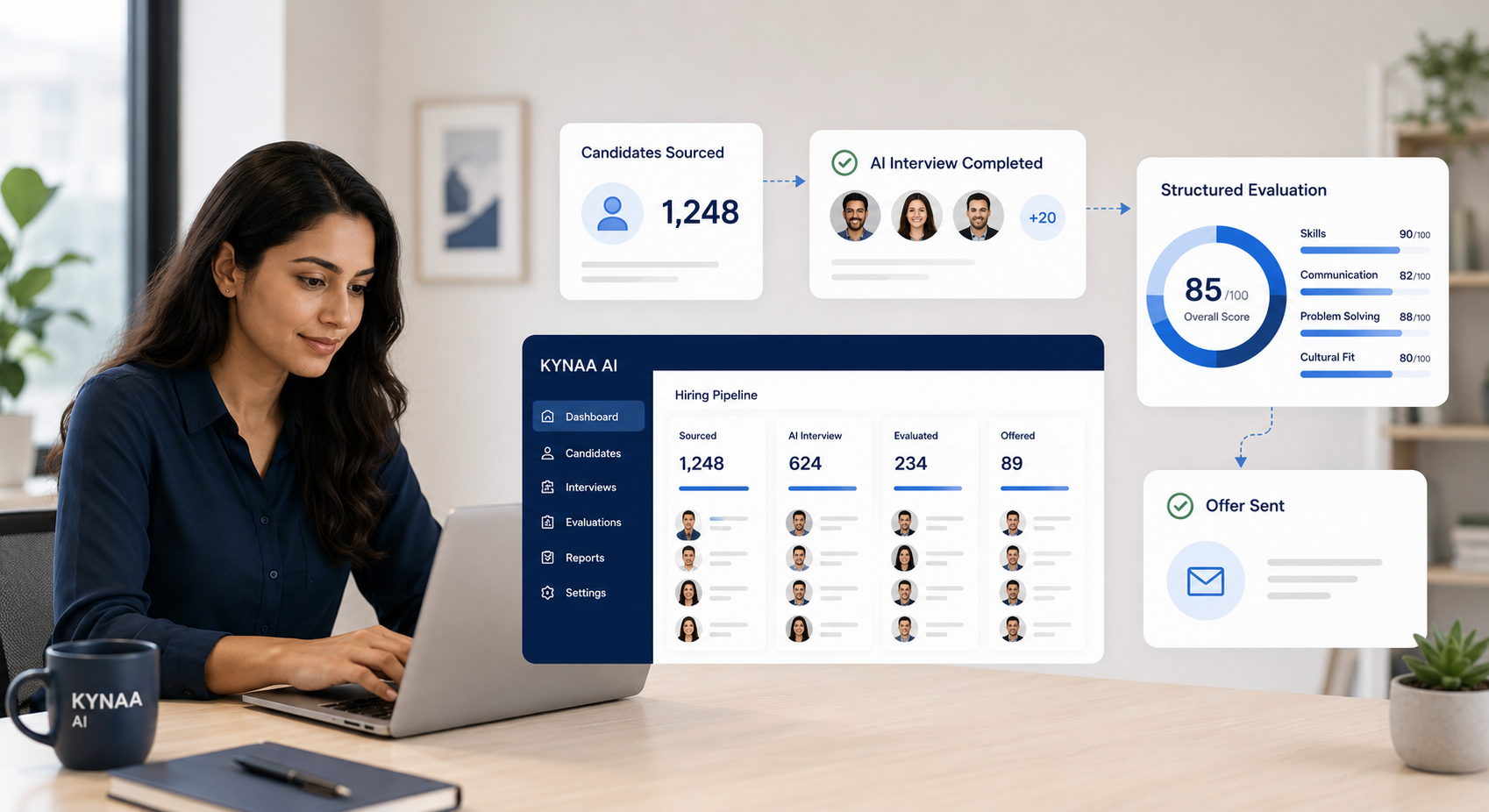
A crew of AI agents runs your whole talent journey, from the job description to the signed offer, on talent already assessed on partner campuses. Every score shows its work. Every decision waits for your sign-off.

Pre-assessed talentProctored assessments, verified projects, mock rounds, done before you ever open a role.
Scores that show their workScore, factors, evidence, confidence. Defensible to a hiring manager or an auditor.
You keep the controlsAgents draft, source, screen and schedule. Nothing moves without a named person saying yes.
Scroll to taxi

No job-board noise. Two clean inlets.

Kynaa does not scrape LinkedIn or repost to portals. Candidates reach your pipeline two ways, and both come with evidence attached.

The Kynaa talent pool

Students assessed on partner campuses.

Every student on a Kynaa campus builds a record before placement season: proctored assessments, verified projects, structured mock rounds and a readiness score. You search that pool by role family, skill and campus, and every profile opens into its evidence.

  • Enrollment verified through the university
  • Projects verified against source and write-ups
  • Assessments proctored and scored against the role

Resumes you upload

Your own applicants, past candidates, silver medalists.

Drop in the resumes you already have. The Screening Agent reads every one against your must-haves and weights, so nobody gets buried in a pile, and every score comes back with its reasons.

  • Bulk upload, every resume read
  • Scored on the same weights as the talent pool
  • Past applicants resurfaced when a new role fits

Your tower. Every runway light on one screen.

This is Kynaa Corporate. Search the talent pool, open any score, build a shortlist, watch the pipeline move. It's live below with demo data, so click around.

Talent poolBackend Engineer · 2026 batch · 6 partner campuses
Shortlist · 0Agents: 3 active
Select a candidate to open the score chain.
Every column boundary is a human gate. Agents prepare the move; a named person makes it.
Stage conversionBackend Engineer, this quarter
Sourced412
Screened256
Assessed88
Interviewed29
Offered6
Where hires came fromAll roles, last two seasons
68%talent pool
Kynaa talent poolUploaded resumes
Ask the Reporting AgentPlain English in, report out
Which campus gave us the most finalists this year?
VIT Vellore produced 9 of 29 finalists across Backend and Data roles, followed by BITS Dubai with 7. Finalists from VIT had the highest average project-verification rate (94%).Sources: pipeline records, campus verification log
Demo data. Illustrative candidates, not real people.

Ten stages. Every one says who does what.

At every stage the split is the same: agents do the legwork, you make the call.

Stage 01 of 10

Demand

Know which roles you actually need, before you post a word.

AgentsPull hiring needs into one view and draft the requisition.
You decideApprove the headcount. Nothing opens without it.

Meet the crew that never sleeps.

Kynaa isn't one AI bolted onto a form. It's a crew of specialised agents, each trained for one job on the strip, and every one of them reporting to you.

Sourcing Agent

Finds the candidates.

Searches the assessed talent pool for real matches to your must-haves, and brings the evidence with every name it surfaces.

Reports to you: a shortlist with reasons, never just names.

Screening Agent

Scores every resume.

Reads every application against your weights and knockout questions. No resume goes unread, and every score shows its work.

Reports to you: scores with factors, evidence and confidence attached.

Interview Agent

Runs the first conversation.

Structured screening interviews: same questions for every candidate, every answer scored the same way. Consistent, fair, on the record.

Reports to you: transcripts and scores. Your team decides who advances.

Copilot

Answers everyone, anytime.

Candidates get status and answers around the clock instead of silence. Your team gets a co-editor inside every workspace.

Reports to you: what candidates are asking, so nothing festers.

Recommendation Agent

Suggests the next move.

Who to shortlist, which role is stalling, when an offer is at renege risk. Recommendations arrive with reasons while there's still time to act.

Reports to you: a suggestion and its why. The move is yours.

Reporting Agent

Writes the reports.

Pipeline health, stage conversion, campus performance, time to close. Ask in plain English, get the report. No export, no spreadsheet surgery.

Reports to you: literally. That's the job.

Great hires start with an honest job description.

Most job descriptions are wish lists written in a hurry. Then every stage downstream pays for it.

JD Studio treats the description as the foundation it is. You bring the hiring brief; the agent drafts alongside you, in your words. Must-haves get locked as real requirements. Knockout questions get built from them. Nothing leaves the studio until the hiring manager signs off.

JD StudioStep 1 of 5

Don't take our word for it. Move the weights.

Scoring weights aren't ours, they're yours, set per role family. Change what matters and watch the ranking answer. In the product you preview exactly this before any change goes live.

Weight StudioRole family: Backend Engineer
Weights normalise to 100%
Live re-rankPreview, nothing committed
Illustrative candidates, not real people.

Nothing ships without a human sign-off.

Autonomy without accountability is how hiring tools lose trust. Kynaa is built the other way around.

Approvals at every gate

Requisitions, job specs, shortlists, offers. Each one waits for a named person to say yes.

Reasons attached to everything

Every recommendation carries its factors, evidence and confidence, so a review reads the record instead of reconstructing it.

Overrides teach the system

When your people disagree with a score, that's not friction, that's signal. The system asks why, and learns.

Thirty minutes. One real role. End to end.

Bring the role you're struggling to fill. We'll walk it down the strip, from the job description to the signed offer, and you keep the controls the whole way.

Kynaa for Universities and Students

You built the flight school. We built the runway.

Kynaa is the platform universities bring to their students: verified profiles, evidence-based matching, and live visibility from first application to signed offer. For your placement office and every student in the cohort.

Departures · Class of 2026--:--
StudentProgramDestinationStatus
Ananya N.B.Tech CSE '26 · VIT VelloreBengaluru · BackendOffer signed
Rahul S.B.Tech IT '26 · MIT ManipalPune · ProductOffer
Fatima K.B.E. CSE '26 · BITS DubaiDubai · CloudInterview
Vikram J.BCA '26 · ChristHyderabad · SaaSScreening
Sneha R.B.Tech ECE '26 · NIT TrichyChennai · AnalyticsInterview
Arjun M.B.Tech CSE '27 · SRMGurugram · FrontendProfile verified
Live view. Your placement office sees this in real time. Illustrative board, not real students or offers.
Scroll to taxi

The placement office, with the lights on.

Placement season shouldn't be a spreadsheet reconstructed from phone calls. This is Kynaa University, live below with demo data. Slice the cohort, open a drive, see who needs a nudge.

TowerClass of 2026 · live
Cohort funnelVerified profile to signed offer
Readiness by skillCohort average, before the next drive
Backend
Data structures
System design
Signal: Google and Meta weighted system design 40% this season. That's the gap to close before the next drive.
Every number here traces back to a verified, signed offer on the platform. When leadership asks, the evidence is one click deep.
You choose which drives open and which recruiters see the cohort. Agents keep the drive moving; the placement cell decides.
Select a student to see why they're flagged and what would help.
Flagged while there's still a semester left to act, not discovered after convocation. The students who need you most are the ones who don't come asking.
Demo data. Illustrative students, not real people or placements.

Every student gets their own runway.

Your students don't sign up off the street. They come through you, verified from day one. This is what's waiting for them: Kynaa Student, live with demo data.

MG
Mayank GuptaB.Tech CSE '26 · VIT Vellore
Day 7 streak
53readiness, up from 47
Verified through the university
EnrollmentPython · assessedSQL · assessedCapstone project
Matches, on evidence tap one
Applications
Copilot 2:04 AM
What should I prepare for Thursday's Google interview?
The screening round is structured: same questions for everyone. Expect two system-design prompts weighted 40% this season, one on data modelling. Your weakest verified area is system design (44). I've queued two mock rounds for tonight. Want to start the first one now?
A profile that proves, not claims.Skills, projects and credentials verified through the university. When a company reads it, they're reading evidence, which is why they keep reading.
Matched on what they can do.Recommendations built on verified evidence and the role's real requirements. Students see what a role needs, where they stand, and what would move them forward.
No more application black hole.Every application has a status a student can actually check: screening, interview, offer, signed. Silence is the one answer Kynaa doesn't allow.
A copilot in their corner.Answers questions, helps them prepare, keeps them moving. At 2 AM before the interview, when the placement office is closed.
The same fair interview, for everyone.Screening interviews ask every candidate the same questions and score every answer the same way. No good-mood interviewer, no bad-slot luck.
Momentum, one day at a time.Daily streaks and small wins keep profiles growing all semester, so students arrive at placement season ready, not scrambling.
Demo data. Illustrative profile, not a real student.

Students join through you. That's the point.

Kynaa isn't an open job board with your logo on it. Access, cohorts and verification run through the university, which is exactly why companies trust the pool, and why your students stand out in it.

1record per student, shared with recruiters
0applications that go silent
100%of placement numbers trace to a signed offer

Start with one cohort. The board does the convincing.

You don't have to move the whole university on day one. One program is enough to see it work.

Step 01 of 4

Pick a cohort

One program or department, wherever placement season matters most this year.

YouChoose the program and the batch.
KynaaSets up the cohort, the verification links and the drive calendar.

Give one cohort the runway.

Bring your placement head and thirty minutes. We'll walk one program through the platform, from a student's first verified profile to the signed offer on your board.

Book a demo

No slide deck. No maybe-laters. Watch the lights come on.

Thirty minutes with a real role or a real cohort, live on the platform, not in a presentation. File the flight plan below and we'll come back to you to set a time.

File the flight plan
Scroll to taxi

Flight plan

Demo request

Bring a role you're actually hiring for. We'll fly it end to end.

Please add your name.
That email doesn't look right.
Please add your organization.
Please add a phone number we can reach you on.
Please add your title.

We use these details to schedule your demo. Nothing else.

Flight plan filed.

Back to the runway

Thirty minutes. Zero theatre.

This isn't a pitch meeting. It's your scenario, live on the strip.

1
You file the planTell us who you are and what to prepare: a role you're hiring for, or a cohort heading into placement season.
2
We load your scenarioYour role or program goes into the platform before the call, so the demo starts on your problem, not on a welcome slide.
3
We fly it end to endJob description to signed offer, or first verified profile to the departures board, with every AI decision showing its work along the way.
4
You keep the controlsMove the scoring weights yourself. Ask the awkward questions. If it can't survive thirty minutes of poking, it doesn't deserve your hiring.

Students: access to Kynaa comes through partner universities. Tell us where you study and we'll take the conversation to your placement office. That's the fastest runway to getting your whole cohort on board.

Prefer to just write?

Skip the form. Email us with who you are and what you'd like to see, and we'll take it from there.

kynaa@namasys.ai